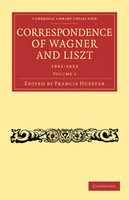
Francis Hueffer (1845-89) was born and studied music in Germany, but moved to London in 1869 to pursue a career as a critic and writer on music. He edited the series 'The Great Musicians' for Novello and Co., was music critic of The Times, wrote libretti for some now-forgotten operas, and was an early advocate and interpreter to the British of Wagner. As well as writing Wagner in his own 'Great Musicians' series (1881), and Richard Wagner and the Music of the Future (1874), he translated the correspondence of Wagner and Liszt. This fascinating two-volume selection, published in 1888, covers the period 1841-61. Hueffer signals in his preface the importance to Wagner of the encouragement of Liszt - an established performer when Wagner was barely known and widely ridiculed, a musical mentor, an enthusiastic critic and eventually a father-in-law.
This work has been selected by scholars as being culturally important and is part of the knowledge base of civilization as we know it.This work is in the public domain in the United States of...
This book has been considered important throughout the human history, and so that this work is never forgotten we have made efforts in its preservation by republishing this book in a modern format...
This work has been selected by scholars as being culturally important, and is part of the knowledge base of civilization as we know it.This work is in the "public domain in the United States of...