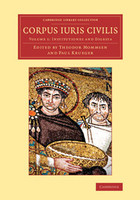
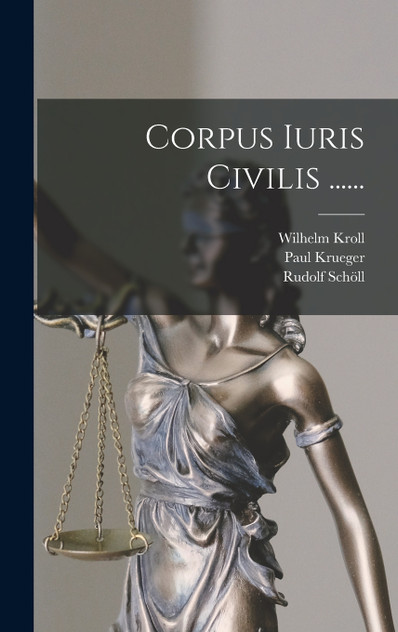
The most famous legal work of the ancient world was compiled at the order of the emperor Justinian (c.482-565) and issued in the period 529-34. It was intended to be a complete codification of all law, to be used as the only source of law in all the courts of the empire. The work was divided into three parts: the Codex Justinianus contained all of the extant imperial enactments from the time of Hadrian; the Digesta compiled the writings of great Roman jurists; and the Institutiones was intended as a textbook for law schools. However, Justinian later found himself obliged to create more laws, and these were published as the Novellae. This three-volume Latin edition of 1872-95, prepared by the great classical historian Theodor Mommsen (1817-1903) and his colleagues, is the culmination of centuries of palaeographical and legal studies. Volume 1 contains the Institutiones and Digesta.
This work has been selected by scholars as being culturally important, and is part of the knowledge base of civilization as we know it.This work is in the "public domain in the United States of...
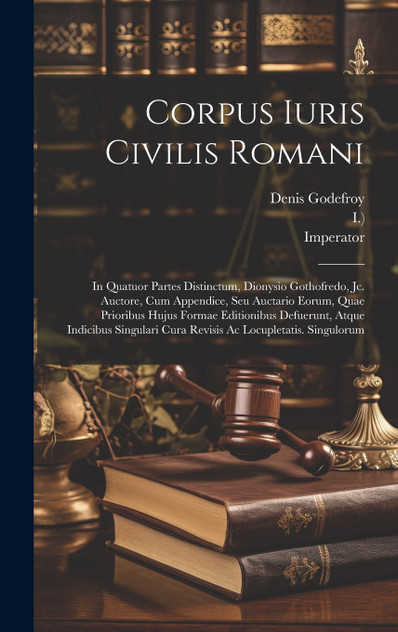
This monumental work of legal scholarship is an invaluable resource for anyone studying ancient Roman law. Compiled in the 6th century, the Corpus Iuris Civilis Romani includes the Codex Justinianus,...
This is a reproduction of a book published before 1923. This book may have occasional imperfections such as missing or blurred pages, poor pictures,...
This comprehensive examination of Roman law is a must-have for any legal scholar. Freiesleben provides a detailed look at the Corpus Juris Civilis - a collection of Roman legal texts that had a...
This work has been selected by scholars as being culturally important, and is part of the knowledge base of civilization as we know it. This work was reproduced from the original artifact, and...