Trending Bestseller

Cooperative Networks in Fading Channels

Stefano Savazzi

No reviews yet Write a Review
Paperback / softback
17 February 2010
RRP: $109.21
$88.00
Ships in 5–7 business days
Hurry up! Current stock:
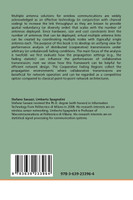
Multiple antenna solutions for wireless communications are widely acknowledged as an effective technology (in conjunction with channel coding) to increase the link throughput as they are known to provide spatial redundancy (or diversity order) that scales with the number of antennas deployed. Since hardware, size and cost constraints limit the number of antennas that can be deployed, virtual multiple antenna links can be created by coordinating multiple nodes with (typically) single antenna each. The purpose of this book is to develop an unifying view for performance analysis of distributed (cooperative) transmissions under arbitrary (or unbalanced) fading conditions. The main focus of the analysis is twofold: we first evaluate how the propagation settings (e.g., the fading statistic) can influence the performances of collaborative transmission; next we show how this framework can be helpful for efficient network design. The Cooperative Fading Regions collect the propagation environments where collaborative transmissions are beneficial for network operation and can be regarded as a competitive option compared to classical point-to-point network architectures.

This product hasn't received any reviews yet. Be the first to review this product!

RRP: $109.21
$88.00
Ships in 5–7 business days
Hurry up! Current stock:

Cooperative Networks in Fading Channels

RRP: $109.21
$88.00

Description

Multiple antenna solutions for wireless communications are widely acknowledged as an effective technology (in conjunction with channel coding) to increase the link throughput as they are known to provide spatial redundancy (or diversity order) that scales with the number of antennas deployed. Since hardware, size and cost constraints limit the number of antennas that can be deployed, virtual multiple antenna links can be created by coordinating multiple nodes with (typically) single antenna each. The purpose of this book is to develop an unifying view for performance analysis of distributed (cooperative) transmissions under arbitrary (or unbalanced) fading conditions. The main focus of the analysis is twofold: we first evaluate how the propagation settings (e.g., the fading statistic) can influence the performances of collaborative transmission; next we show how this framework can be helpful for efficient network design. The Cooperative Fading Regions collect the propagation environments where collaborative transmissions are beneficial for network operation and can be regarded as a competitive option compared to classical point-to-point network architectures.

Customers Also Viewed