Trending Bestseller

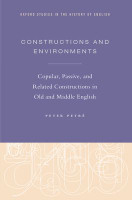
Constructions and Environments

No reviews yet Write a Review
This book describes and analyzes various changes in the distribution of copular and passive verb constructions in Old and Middle English, and, by way of these case studies, presents and tests several new theories that have major implications for construction grammar and linguistic change.
Hardback
25-September-2014
320 Pages
RRP: $257.00
$149.00
Ships in 5–7 business days
Hurry up! Current stock:
This monograph presents the first comprehensive diachronic account of copular and passive verb constructions in Old and Middle English. Peter Petré analyzes: · The mysterious loss of the high-frequency verb weorðan 'become' as a casualty of changing word order in narrative during Middle English. · The merger of is 'is' and bið 'shall be, is generally' into a single suppletive verb, and how it is related to the development of a general analytic future shall be. · The co-occurrence of multiple changes that led to become and wax crossing a threshold of similarity with existing copulas, from which they analogically adopted full productivity in one fell swoop. In explaining each of these changes, Petré goes beyond the level of the verb and its complements, drawing attention to analogical networks and the importance of a verb's embeddedness in clausal and textual environments. Using a radically usage-based approach, treating syntax as emerging from (changing) frequencies, Petré draws attention to general principles of constructional change, including but not limited to grammaticalization and lexicalization. He proposes novel parallelisms between linguistic and ecological evolution. Going beyond the view of language change as propagating only in social interaction, Petré explains how each individual's mental grammar can be seen as a dynamic ecosystem with hierarchical environments (clausal niches, textual habitats). In this view, the interconnectedness of seemingly unrelated changes, itself resulting from cognitive economy principles, is arguably more decisive in lexical change than is functional competition.

This product hasn't received any reviews yet. Be the first to review this product!

RRP: $257.00
$149.00
Ships in 5–7 business days
Hurry up! Current stock:

Constructions and Environments

RRP: $257.00
$149.00

Description

This monograph presents the first comprehensive diachronic account of copular and passive verb constructions in Old and Middle English. Peter Petré analyzes: · The mysterious loss of the high-frequency verb weorðan 'become' as a casualty of changing word order in narrative during Middle English. · The merger of is 'is' and bið 'shall be, is generally' into a single suppletive verb, and how it is related to the development of a general analytic future shall be. · The co-occurrence of multiple changes that led to become and wax crossing a threshold of similarity with existing copulas, from which they analogically adopted full productivity in one fell swoop. In explaining each of these changes, Petré goes beyond the level of the verb and its complements, drawing attention to analogical networks and the importance of a verb's embeddedness in clausal and textual environments. Using a radically usage-based approach, treating syntax as emerging from (changing) frequencies, Petré draws attention to general principles of constructional change, including but not limited to grammaticalization and lexicalization. He proposes novel parallelisms between linguistic and ecological evolution. Going beyond the view of language change as propagating only in social interaction, Petré explains how each individual's mental grammar can be seen as a dynamic ecosystem with hierarchical environments (clausal niches, textual habitats). In this view, the interconnectedness of seemingly unrelated changes, itself resulting from cognitive economy principles, is arguably more decisive in lexical change than is functional competition.
Customers Also Viewed