Trending Bestseller

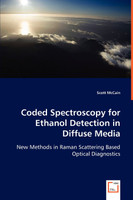
Coded Spectroscopy for Ethanol Detection in Diffuse Media

Scott McCain

No reviews yet Write a Review
Paperback / softback
02 July 2008
RRP: $78.69
$63.00
Ships in 3-5 business days
Hurry up! Current stock:
Optical sensing in the visible and near-infrared regions of the electro­magnetic spectrum allows for non-invasive analysis of tissue. With the use of Raman spectroscopy, a high degree of chemical specificity is available with laser powers that are harmless to living tissue. Such systems, however, are plagued by the low efficiency of the Raman scattering process by molecules and the intense background fluorescence from some biological materials. To address these draw­backs, we have investigated the use of coded spectroscopy to make Raman spectroscopy more feasible in routine use. By coding the input aperture of a dispersive spectrometer, throughput gains of 10-100 are possible over a slit spectrometer. The theory, design, and performance characteristics of this static aperture coding will be discussed in this work. In addition, by coding the excitation light sources one can filter out the shifting Raman signals from the stationary fluorescent back­ground. The theory and implementation of an expectation maxi­mization algorithm for Raman signal reconstruction will be analyzed. The design of a multi-excitation, coded-aperture Raman spectrometer will be described.

This product hasn't received any reviews yet. Be the first to review this product!

RRP: $78.69
$63.00
Ships in 3-5 business days
Hurry up! Current stock:

Coded Spectroscopy for Ethanol Detection in Diffuse Media

RRP: $78.69
$63.00

Description

Optical sensing in the visible and near-infrared regions of the electro­magnetic spectrum allows for non-invasive analysis of tissue. With the use of Raman spectroscopy, a high degree of chemical specificity is available with laser powers that are harmless to living tissue. Such systems, however, are plagued by the low efficiency of the Raman scattering process by molecules and the intense background fluorescence from some biological materials. To address these draw­backs, we have investigated the use of coded spectroscopy to make Raman spectroscopy more feasible in routine use. By coding the input aperture of a dispersive spectrometer, throughput gains of 10-100 are possible over a slit spectrometer. The theory, design, and performance characteristics of this static aperture coding will be discussed in this work. In addition, by coding the excitation light sources one can filter out the shifting Raman signals from the stationary fluorescent back­ground. The theory and implementation of an expectation maxi­mization algorithm for Raman signal reconstruction will be analyzed. The design of a multi-excitation, coded-aperture Raman spectrometer will be described.

Customers Also Viewed