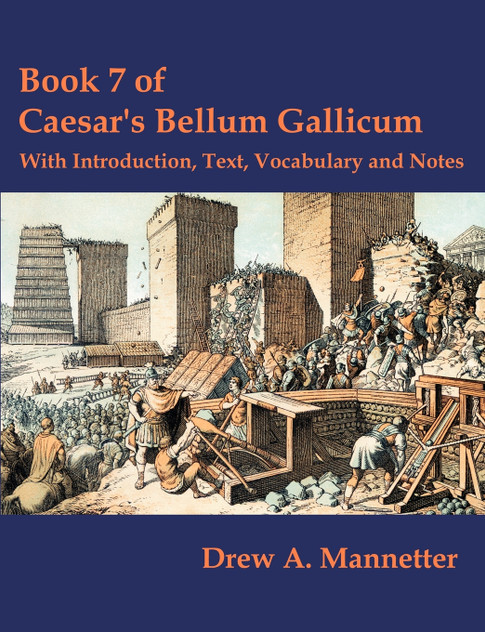
This is the first commentary on Caesar's Bellum Gallicum to approach it as a literary text. It attempts a contextualized reading of the work through the eyes of a contemporary Roman reader, who was trained in rhetoric, versed in Greek and Roman literature, and familiar with the same political and cultural conventions and discourses as its author. In appreciating Caesar as a writer and situating the seventh book of the Bellum Gallicum within its 'horizon of expectations' and especially its historiographical tradition, it reveals much that rewards careful attention, including: a dramatized narrative, sustained intertextual borrowings and allusions (especially from and to Thucydides and Polybius), (in)direct speeches telling of Rome's second-greatest speaker, and word- and sound-play telling of the leading linguist, not to mention artful technical descriptions that lack parallels in the Roman republic. Ultimately, both author and text emerge as quite different from their grossly generalized reputations.
This comprehensive reader utilizes a step-by-step approach to help students of Latin read and understand the longest and most dramatic book of Caesar's Gallic War. Book 7 is the culmination of the...
This work has been selected by scholars as being culturally important, and is part of the knowledge base of civilization as we know it. This work was reproduced from the original artifact, and...
Das Buch ""Atlas Zu Caesars Bellum Gallicum: Fur Die Schule Bearbeitet (1889)"" von Clemens Friedrich Meyer ist ein Atlas, der speziell f�����r den Einsatz in Schulen konzipiert wurde. Der Atlas...
This work has been selected by scholars as being culturally important, and is part of the knowledge base of civilization as we know it. This work was reproduced from the original artifact, and...
Written by one of history's greatest military leaders, Julius Caesar's Bellum Gallicum is an extraordinary account of the Roman conquest of Gaul. Books V and VI cover some of the most exciting events...