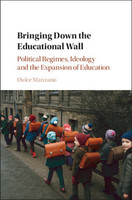
Bringing Down the Educational Wall studies the causes of educational expansion in a global sample of developing and developed countries from 1960 to 2005. The book explores how the interaction between the economic context of nations (economic development and inequality) and political factors (the type of political regime and the ideology of dictatorships) influences countries' educational outcomes. The book's main contributions are the exploration of ideological differences between autocratic regimes and the tracing of changes in different parts of the income distribution, which accounts for education expanding to broad sectors of the population. Bringing Down the Educational Wall introduces a new database on the ideology of dictatorships and uses quantitative methods and case analyses to test its theoretical arguments. This work will help students in comparative politics and political economy courses to develop their understanding of redistributive policies and the effects of political factors on the expansion of education.
In his first collection of writings to be published in English, Fang Lizhi, the world-renowned Chinese astrophysicist and human rights activist, speaks out on science, culture, and the future of...
Meng Jiangnü Brings Down the Great Wall brings together ten versions of a popular Chinese legend that has intrigued readers and listeners for hundreds of years. Elements of the story date back to the...
The 43rd Volume of Research in Social Movements, Conflicts and Change continues the series' tradition of publishing peer reviewed chapters, which advance our understanding of peace, political...
This is a story about bullying and how dangerous it can be. Mike Decker and Jimmy Pittenger want to protect a new student named Fletcher from being bullied by Sam Newman. It's Fletcher's first day at...