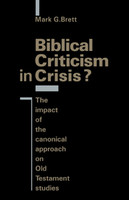

This book suggests that Old Testament scholars should strengthen their growing links with neighbouring academic disciplines and encourage a number of interpretative interests within biblical studies. Given such a pluralistic context, the author's contention is that the 'canonical' approach to Old Testament study will have a distinctive contribution to make to the discipline without necessarily displacing other traditions of historical and literary inquiry, as many scholars have assumed. Dr Brett offers a comprehensive critique of the canonical approach as developed by Brevard Childs, and examines the development of Childs's exegetical practice, his hermeneutical theory, and the many critical responses which his work has elicited. In responding to these criticisms, the author examines the most problematic aspects of the canonical approach (notably Childs's inadequate reply to those who emphasize the ideological conflicts that lie behind biblical texts in their final form) and seeks to reconstruct the approach in light of contemporary discussions of interpretation in literary theory and the social sciences.
This work has been selected by scholars as being culturally important, and is part of the knowledge base of civilization as we know it.This work is in the "public domain in the United States of...
""A Declaration On Biblical Criticism: By 1725 Clergy Of The Anglican Communion (1906)"" is a book that contains a historical document written by a group of Anglican clergy in 1725. The document is a...
*With a foreword from Tim Keller*A bold vision for Christians who want to engage the world in a way that is biblically faithful and culturally sensitive.In Biblical Critical Theory, Christopher...