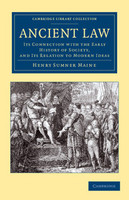
This hugely influential work of 1861 is probably the one for which Sir Henry Maine (1822-88) is best remembered. Appointed Regius Professor of Civil Law at Cambridge when he was only twenty-five, Maine then became Reader in Roman law and jurisprudence at the Council of Legal Education, which had been established in London in 1852 by the Inns of Court, and combined this post with research and journalism. He was interested in the relationship between the law and the society that both shaped it and consented to be regulated by it, and drew on historical examples from the culture of many Indo-European societies to further his arguments on the development of law as a vital component of civilisation. Published at a time when the evolution of institutions as well as of species was a topic of widespread interest, this remains a landmark work in the intellectual history of legal studies.
This work has been selected by scholars as being culturally important, and is part of the knowledge base of civilization as we know it.This work is in the "public domain in the United States of...
First published in the mid-19th century, this groundbreaking work remains an essential resource for scholars of Irish history and law. A comprehensive glossary of the legal terms and concepts used in...
The Making of Modern Law: Foreign, Comparative and International Law, 1600-1926, brings together foreign, comparative, and international titles in a single resource. Its...
This work has been selected by scholars as being culturally important, and is part of the knowledge base of civilization as we know it.This work is in the "public domain in the United States of...