An Inquiry into the Human Mind, on the Principles of Common Sense
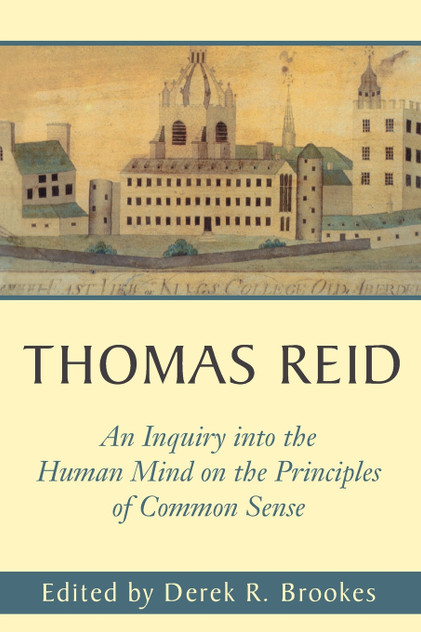
Thomas Reid (1710-96), the Scottish natural and moral philosopher, was one of the founding members of the Aberdeen Philosophical Society and a significant figure in the Scottish Enlightenment. Reid believed that common sense should form the foundation of all philosophical inquiry. He criticised the sceptical philosophy propagated by his fellow Scot David Hume and the Anglo-Irish bishop George Berkeley, who asserted that the external world did not exist outside the human mind. Reid was also critical of the theory of ideas propagated by Locke and Descartes, arguing that it was incompatible with physical and experiential facts. For Reid, our senses demonstrate that the external world must exist, and this work is organised in chapters examining each of the senses in turn. The book, based on his lectures, was first published in 1764 when Reid was a regent professor at King's College, Aberdeen, and was reissued in 1818.
The 18th century was a wealth of knowledge, exploration and rapidly growing technology and expanding record-keeping made possible by advances in the printing press. In its determination to preserve...
Thomas Reid's Inquiry has long been recognized as a classic philosophical text. Since its first publication in 1764, there have followed no less than forty editions. The proliferation of secondary...
""Essays on The Active Powers of the Human Mind"" is a philosophical work by Thomas Reid, first published in 1788. The book is an inquiry into the human mind on the principle of common sense. Reid...
This work has been selected by scholars as being culturally important, and is part of the knowledge base of civilization as we know it.This work is in the "public domain in the United States of...