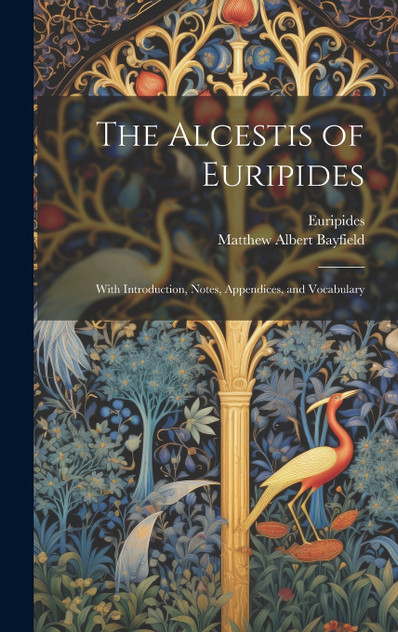
T. W. C. Edwards' edition of Monk's 1816 translation of Euripides' Alcestis was published in 1824. Edwards used the earlier work to form the basis of a parallel pedagogic text, adding copious notes for the use of students of ancient Greek. Alcestis is Euripides' earliest surviving play; a 'problem play' that shares much with tragedy, but has a happy ending. Admetus marries Alcestis, who offers to die in his place after he angers the goddess Artemis. She is rescued from death by Heracles who returns her in disguise to her husband. Admetus refuses to marry this unknown woman, having vowed celibacy after what he believed was his wife's death, but she is revealed as Alcestis to much rejoicing. The play was originally performed at the Athenian Dionysia in 438 BC, where it formed the final part of an otherwise lost tetralogy of plays, replacing the traditional satyr play.
This edition of Euripides' tragedy is designed for students who are learning Ancient Greek. It includes vocabulary and notes to help with translation, as well as appendices that provide historical...
Alcestis is one of Euripides' richest and most brilliant - as well as most controversial - plays. But, apart from D. J. Conacher's student text, no annotated edition in English has appeared for more...
This scarce antiquarian book is a facsimile reprint of the original. Due to its age, it may contain imperfections such as marks, notations, marginalia and flawed pages. Because we believe this work...