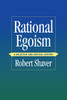
The position of rational egoism centres upon the thought that the rational thing to do must be to pursue one's own self-interest. Focusing on the work of Hobbes and Sidgwick, this book is an extensive history and evaluation of rational egoism. They are, after the ancients, the foremost exponents of rational egoism. He also considers other figures - Grotius, Samuel Clarke, John Clarke, Butler, Hume, Reid, Kant, Paley and Bentham - and a related position: the instrumental theory of rationality. Robert Shaver's conclusion is that none of the arguments for rational egoism or the instrumental theory are cogent. This is an important book not just for historians of philosophy but for all readers in philosophy or the social sciences interested in theories of morality and rationality.
In this thought-provoking book, Louis Wallis explores the relationship between egoism and religion. Wallis argues that the needs of the individual self must be balanced with the demands of society in...
Sacro-Egoism: The Rise of Religious Individualism in the West discusses the relationship between secularization, participation in religious practices and belief, and the emergence of radical...
This work has been selected by scholars as being culturally important, and is part of the knowledge base of civilization as we know it.This work is in the "public domain in the United States of...